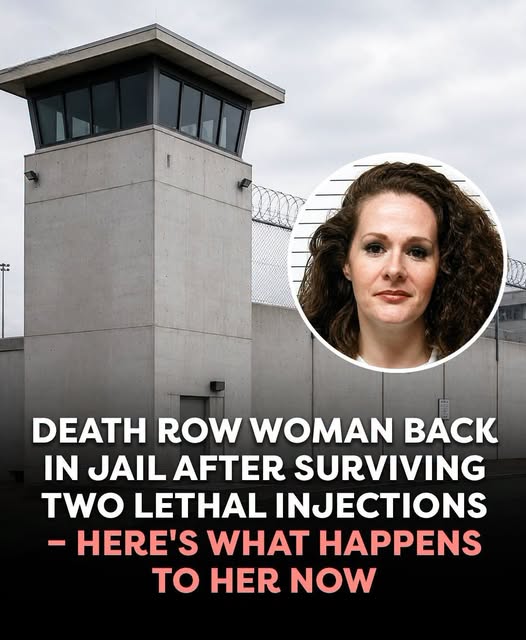
Christa Pike has returned to prison after surviving a botched execution in Tennessee, with the death row inmate still facing an uncertain future following the failed lethal injection.
The 50-year-old was taken to hospital after officials attempted to execute her on September 30, administering two doses of the execution drug pentobarbital.
However, Pike survived the procedure, which has since prompted questions about how the execution was carried out and whether the state could attempt to put her to death again.
Her lawyers have now confirmed that she has been discharged from hospital and returned to the prison where she has spent the past three decades.
The latest development comes as Tennessee investigates the failed execution, while Pike’s legal team continues to monitor her recovery and considers its next steps.
The case has also reignited debate about capital punishment in the US, with calls for Tennessee to consider alternative execution methods following the extraordinary events.
What happened during Christa Pike’s failed execution?
Pike was scheduled to be executed by lethal injection at Riverbend Maximum Security Institution in Tennessee on September 30.
The execution was expected to make her the first woman put to death by Tennessee in more than 200 years.
However, the procedure did not go as planned.
According to reports, medical staff struggled to establish intravenous access, with Pike reportedly being stuck with needles at least seven times.
She was subsequently given two doses of pentobarbital, the drug used in the state’s lethal injection procedure, but she did not die.
Pike was taken to hospital for treatment after suffering serious complications.
Her legal team has since raised concerns about what happened inside the execution chamber, including reports that she complained of burning sensations in her arms during the procedure.
Witnesses also described the execution as deeply troubling, while state officials have maintained that the approved protocol was followed.
There has been no definitive public explanation for why Pike survived.
Medical experts have suggested that problems with intravenous access could have meant some or all of the drug entered the surrounding tissue rather than reaching her bloodstream as intended. Other possible explanations have also been discussed, but the precise cause remains unconfirmed.
The incident has prompted calls for a thorough investigation into the circumstances surrounding the failed execution.
Why was Christa Pike sentenced to death?
Pike has been on death row for more than 30 years following the murder of 19-year-old Colleen Slemmer in January 1995.
Pike was 18 at the time and was attending the Knoxville Job Corps programme alongside Slemmer.
The two women were classmates, and the killing was linked to Pike’s belief that Slemmer was trying to take her boyfriend, Tadaryl Shipp.
According to court records, Pike and Shipp took Slemmer to a wooded area on the University of Tennessee campus, where she was tortured and beaten to death.
A pentagram was carved into Slemmer’s chest, and Pike reportedly kept a fragment of her victim’s skull.
The brutality of the murder shocked the community and became one of Tennessee’s most notorious criminal cases.
Pike was convicted and sentenced to death, while Shipp received a life sentence because he was under 18 at the time of the crime.
Pike’s lawyers have since argued that her sentence should be commuted to life imprisonment without the possibility of parole.
They have highlighted her age at the time of the murder, her reported history of sexual abuse and her mental health diagnoses, including bipolar disorder and post-traumatic stress disorder.
These arguments form part of the defence’s case for clemency, although they do not automatically overturn her conviction or death sentence.
In an earlier clemency petition, Pike expressed remorse for the killing and acknowledged the lasting impact her actions had on Slemmer’s loved ones.
Her legal team has maintained that life imprisonment without parole would still constitute a severe punishment without subjecting her to another execution attempt.
Could Christa Pike face another execution attempt?
Pike’s survival has raised significant questions about what happens next, particularly if Tennessee eventually seeks to carry out her death sentence again.
Governor Bill Lee has ordered a review of the failed execution and paused executions in Tennessee for the remainder of 2026.
The pause means the state will not carry out further executions during the rest of the year under the current order.
However, it does not mean Pike’s death sentence has automatically been overturned.
Her lawyers are examining the circumstances surrounding the failed procedure and have indicated that they are preparing to challenge any attempt to execute her again.
The precise legal arguments will depend on the evidence uncovered during the investigation and the state’s position on any future execution.
The defence will also need to establish what officials intend to do before deciding on its next steps.
For now, there is no confirmed date for another execution attempt, and Tennessee has not announced a definitive plan for how it would proceed in Pike’s case.

Electric chair raised as possible alternative
The failed lethal injection has also prompted renewed discussion about whether Tennessee could use a different method of execution in the future.
Republican politician Marsha Blackburn, who is running to succeed Lee as governor, has called for the electric chair to be brought back following the incident, according to the Daily Express.
Blackburn’s intervention has added a political dimension to the case, with the debate focusing on whether the state should restore electrocution as an execution method.
However, it is important to distinguish between a proposal and an official decision.
The electric chair has been raised publicly as a possible alternative, but there is no confirmed plan to use it to execute Pike.
Any future decision would depend on the state’s laws, the outcome of the investigation and the policies adopted by the administration responsible for overseeing executions.
The failed procedure has also intensified wider criticism of the death penalty, with opponents arguing that the incident demonstrates the risks associated with lethal injection.
For Pike, the immediate concern remains her health and the possibility that the state could seek to carry out her sentence again once the current pause ends.
Christa Pike’s latest update as she returns to prison
Pike has now been discharged from hospital and returned to the Deborah K Johnson Rehabilitation Center, where she has been imprisoned for approximately three decades.
Her lawyers confirmed the development on Saturday, October 10, in a statement reported by The Guardian.
They said: “She is grateful to the first responders and her medical team for their care in these extraordinary circumstances.”
The legal team added that Pike was continuing to receive medical care at the prison and that they would continue to monitor her recovery.
The update follows earlier reports from her attorney, Stephen Ferrell, that Pike had begun walking again after the failed execution.
Although this marked a significant development, her recovery was far from complete.
Ferrell previously said that Pike remained somewhat confused and was still unable to use her arms very much.
Her lawyers had also raised concerns about her cognitive state, reporting that she could lose her train of thought and struggle to remember what she was doing.
Earlier reports described serious complications following the procedure, including pneumonia and a blood clot.
The full extent of any lasting physical or cognitive damage remains unclear, and her legal team has not confirmed that she has made a complete recovery.
Her return to prison does not resolve the questions surrounding the failed execution or determine what will happen to her death sentence.
For now, Pike remains on death row while she continues to receive medical care and her lawyers monitor her condition.
Tennessee’s investigation is ongoing, and the state’s execution pause remains in place until the end of 2026 under Lee’s current order.
Whether Pike will face another execution attempt, whether her lawyers can secure clemency and whether officials will consider a different method remain unresolved.
For the moment, the immediate focus is on her recovery and the investigation into how a procedure intended to end her life left her critically ill but alive.