Megan had cared for our son since the previous fall, and I trusted her completely. She arrived early, remembered every detail of his routine and sent cheerful photographs throughout the day. In one he might be stacking blocks; in another he would be laughing in his high chair with fruit on his face. Even my husband Ryan, who was slower to trust people, believed we had found an excellent babysitter.
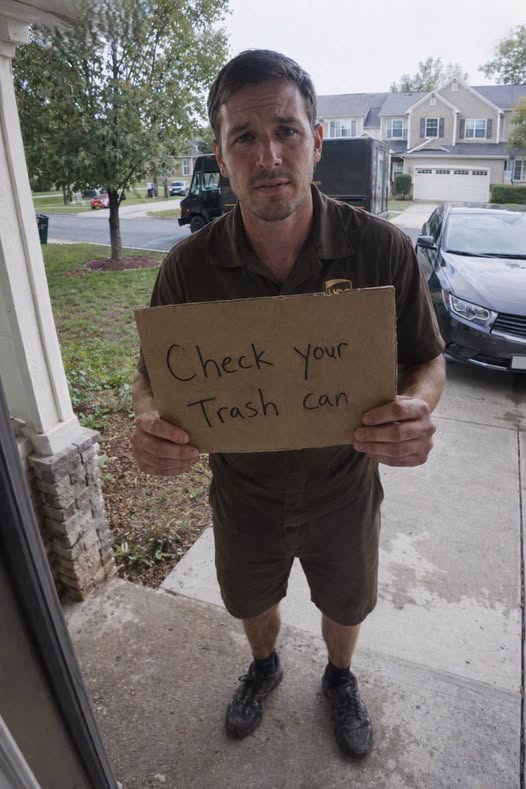
The delivery driver seemed almost comical by comparison. He regularly came to our house and tried to speak through our Ring camera, apparently unaware that its microphone was broken. We could see his mouth moving but never hear him. Nothing about those visits seemed important until the Thursday he stopped, stared toward the side of the house and then held a piece of cardboard up to the camera.
Four words were written on it: “Check your trash can.” He waited long enough to make certain the message had been recorded, nodded and returned to his truck. The warning was so strange that I watched the footage repeatedly. A stranger had noticed something near our home and taken the trouble to leave a message. I could not dismiss it.
I called Megan. She answered on the third ring and sounded calm, but her explanations did not settle me. Ryan and I hurried home, arriving only seconds apart. Our son was unusually drowsy. Megan insisted he was simply tired and resisted the idea that he should be examined. Her reaction made the delivery driver’s warning feel more urgent.
We went to the trash container and found packaging for something we did not buy. The discovery forced us to ask why it had been discarded at our house and what it had to do with our child’s condition. Megan’s calm image began to collapse. The peaceful photographs she sent during the day no longer looked reassuring. They looked like a way to explain why our son was repeatedly asleep.
Evidence suggested that he had been given medication he did not need. What Megan described as ordinary naps may have been the effect of a substance used to keep him quiet and easier to manage. The realization filled me with guilt. I had seen pictures of my sleeping child and accepted the explanation because they came from someone I trusted.
We involved the authorities and sought medical help. Determining exactly what had happened belonged to professionals, not to a confrontation in our kitchen. Megan’s insistence that a hospital visit would only frighten him made matters worse. A responsible caregiver should have welcomed an examination when a child was barely awake. Her resistance showed that protecting herself mattered more to her than ensuring he was safe.
The driver had no obligation to become involved. He could have completed the delivery and continued his route. Instead, he paid attention when he noticed something near the trash and recognized that the people inside might need to know. Because the camera’s audio did not work, he improvised with cardboard. His message gave us the push we needed to look more closely.
I kept returning to the question of how a mother could fail to notice. The answer was not that I did not care. It was that trust had made ordinary explanations feel sufficient. Megan was punctual, organized and skilled at presenting a comforting picture. Those qualities allowed us to relax around her. They also made it harder to imagine that she could be making the same dangerous choice again and again.
We fired her immediately, but ending the arrangement was only the first step. Our son needed evaluation, and the investigation had to establish what he had been given and how often. The experience changed the way we approached childcare. References and routines still mattered, but so did unexpected changes in behavior, unexplained packaging and the willingness of a caregiver to answer difficult questions.
For months, we had laughed about the silent driver trying to talk through a broken microphone. In the end, he was the only outsider who saw something wrong and refused to remain silent. Four handwritten words disrupted the trust we had built, yet they may have prevented something far worse. His intervention did not make us less responsible as parents. It reminded us that protecting a child sometimes begins with listening to the person who notices what everyone else has learned not to see.