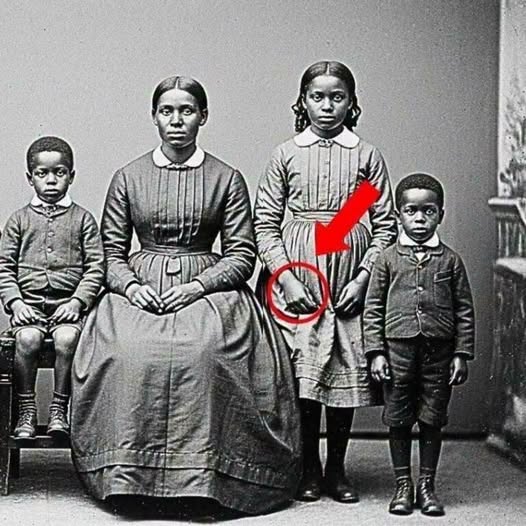
A family portrait taken in 1872 looks ordinary at first: a mother and her children sitting carefully for the camera in typical Victorian style. But then you notice the older daughter’s hand—and what appears to be an extra hand resting beside it. That tiny detail has turned an otherwise ordinary family photograph into a lasting mystery.
Viewers have studied enlarged copies, tracing the arms and trying to determine where the mysterious hand came from. Some believe the image contains something genuinely eerie. Others argue that the answer is far more practical and lies in the limitations of nineteenth-century photography.
Taking photographs in 1872 was nothing like using a smartphone today. Exposure times could be long, meaning subjects had to remain extremely still. Photographers sometimes used posing stands and hidden supports to keep people steady. A support partially hidden by clothing or furniture could potentially create an unusual shape in the finished image.
Double exposure is another possible explanation. If a photographic plate was exposed more than once, overlapping images could appear in the final portrait. Movement during a long exposure could also create blurred or doubled shapes. Because hands have such a recognizable outline, even an incomplete shape can appear surprisingly convincing.
Clothing and shadows may also contribute to the illusion. Victorian sleeves, folds of fabric, and closely positioned arms can merge together in ways that look anatomically impossible. Once someone identifies the shape as an “extra hand,” the brain naturally begins interpreting ambiguous shadows and highlights according to that suggestion.
This phenomenon is known as pareidolia—the tendency to recognize familiar patterns in unclear visual information. It is the same reason people see faces in clouds or figures in shadows. Old photographs are particularly susceptible because fading, scratches, blur, and poor reproduction can remove important visual information.
Unfortunately, the surviving image may not provide enough evidence for a definite answer. Without the original photographic plate, photographer’s notes, or other images from the same session, it is difficult to determine whether the shape resulted from clothing, movement, a hidden support, or a photographic mistake.
That uncertainty is what makes the portrait so fascinating. The family probably viewed the photograph simply as a treasured record of their lives. Today, however, one unexplained detail has transformed it into a historical curiosity. The “extra hand” may never be fully explained, but there is little reason to assume anything supernatural when ordinary photographic techniques offer plausible alternatives.