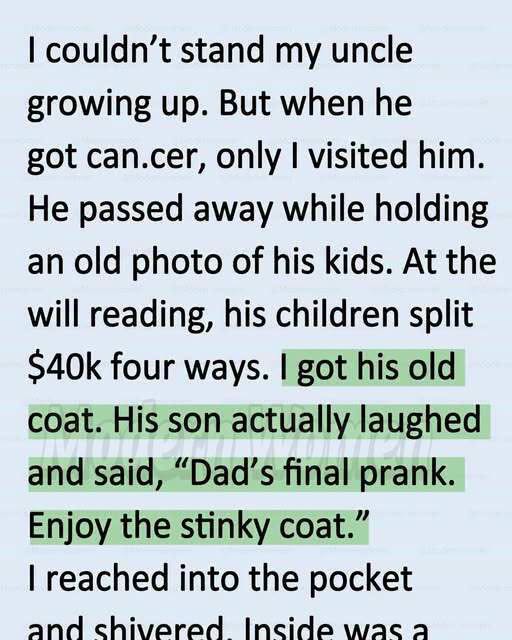
When the lawyer read my late uncle’s will, my entire family erupted into cruel, hysterical laughter as he handed me a threadbare, foul-smelling old coat while his greedy children split thousands in cash! They thought my harsh, bitter uncle had played one final, humiliating prank on me from beyond the grave. For two days, I let that heavy, mysterious jacket sit forgotten in my hallway, feeling deeply embarrassed and betrayed. But when I finally reached into the lining, my fingers brushed against a cold brass key and a hidden letter that instantly silenced my arrogant relatives and turned my whole life upside down!
Growing up, Uncle Richard was universally feared and disliked by the entire extended family. He was a stern, unyielding man whose sharp tongue could cut through a room in seconds. Every family holiday was tainted by his brutal criticism, every accomplishment was brushed off as insignificant, and every conversation felt like an exhausting cross-examination. Over the years, relatives slowly stopped calling, visits grew rare, and people only tolerated him because they knew he had amassed a small fortune through decades of shrewd real estate investments. When news spread that he was dying of terminal cancer, the hypocrisy was overwhelming; relatives suddenly paid superficial attention, quietly calculating what they might inherit once he passed.
I was one of the few who stayed far away, wanting no part in the vulture-like atmosphere surrounding his final days. However, just a week before he passed, my mother begged me to visit him in the hospice ward. Reluctantly, I walked into that sterile hospital room, expecting the same abrasive man I had known my entire life. Instead, I found a frail, hollow shell of a person lying beneath heavy blankets. His booming voice was gone, replaced by a raspy silence as he simply stared at me with unreadable eyes. I sat by his bedside for an hour, awkwardly holding his cold hand and speaking softly, expecting nothing in return. When he passed away three days later, I felt a quiet sadness, believing our distant relationship had ended without any real closure.
The gathering at the probate attorney’s office was packed with relatives practically buzzing with anticipation. Uncle Richard’s adult children sat in the front row, eagerly waiting to claim the massive fortune they believed was rightfully theirs. The lawyer unsealed the documents with agonizing slowness. First, he announced that my cousins would split a modest sum of forty thousand dollars among themselves. Mutters of disappointment immediately filled the room, but the real shock came when the attorney turned his eyes directly toward me. With a straight face, he announced that Uncle Richard had singled me out for a special, personal bequest: a moth-eaten, heavy canvas winter coat that had been sitting in his closet for twenty years.
My cousins burst into loud, mocking laughter, pointing at me and wiping tears from their eyes. They openly mocked the idea that I had spent an hour at his hospice bedside only to walk away with literal trash. They assumed it was a cold, calculated insult from a bitter old man getting the ultimate revenge on the nephew who dared to judge him. Red-faced and deeply embarrassed, I took the heavy, musty garment, threw it into the trunk of my car, and drove home in utter silence. I felt like a complete fool for believing, even for a second, that my final visit to the hospital had meant anything to him.
For forty-eight hours, the coat sat thrown over a chair in my entryway, smelling faintly of old tobacco and damp wool. I was ready to drag it out to the curb for trash day, but a sudden impulse stopped me. I picked it up, intending to donate it if it was salvageable, and began idly checking the pockets. The exterior pockets held nothing but a torn tissue and an old mint wrapper. But as I ran my hands along the heavy inner lining, I felt a strange, stiff outline near the armpit seam. I carefully worked my fingers into a concealed inner pocket that had been deliberately sewn into the fabric.
My heart began to hammer against my ribs as I pulled out a thick, sealed parchment envelope with my name written across the front in my uncle’s sharp, decisive handwriting. Tears welled in my eyes as I broke the seal and began to read his final words. In the letter, Uncle Richard confessed that he had spent his life surrounded by people who only loved him for his bank account. He knew his children viewed him as nothing more than a walking paycheck, waiting eagerly for his demise. He explained that he had purposely acted cold to filter out the opportunists, and that my quiet, unprompted visit to his hospital room—when there was absolutely no financial incentive—had moved him more than I could ever know.
“I left my children enough money to prove I didn’t forget them,” he wrote, “but I left my true legacy to the only person who saw me as a human being when I was at my weakest. The coat is the only thing they wouldn’t fight you for.” Folded beneath the letter was a small, ornate brass key accompanied by a set of official banking documents. The next morning, with my hands shaking uncontrollably, I walked into the downtown bank branch listed in the letter and presented the key to the vault manager.
When the heavy steel safety deposit box was pulled from the wall and opened, I gasped out loud. Inside were the original physical deeds to a prime commercial property located in the heart of the city, completely paid off and free of encumbrances, along with an official appraisal placing its conservative market value at six hundred thousand dollars! Uncle Richard had legally transferred the entire deed into a private trust made out exclusively in my name, effectively making me the sole owner of a massive real estate asset without any of my greedy relatives ever knowing.
The stinky, moth-eaten coat had never been a cruel joke or a bitter humiliation; it was a brilliant shield designed by a dying man to protect his final, life-changing gift from the vultures surrounding his deathbed. My arrogant cousins walked away with a few thousand dollars that vanished in months, while I inherited a life-altering fortune simply because I had chosen to show up with empathy. Today, that old canvas jacket hangs prominently in my home’s cedar closet—not just as a symbol of immense wealth, but as a permanent reminder that genuine kindness is always rewarded, and the greatest treasures are often hidden where no one thinks to look.