My husband, Corbin, would have been furious if he knew I was there. For eight years, he had warned me about the woman next door as if she were a threat that could walk through walls.
“Do not engage with her, Lissa,” he used to say. “She is not safe.”
Then he built the fence.
Twelve feet of black iron rose between our houses, tall enough to block the windows, wide enough to turn a shared yard into two separate worlds. He said it was protection. He said it was privacy. He said she had crossed lines I didn’t understand.
And I believed him.
That morning, standing in the rain, I realized how strange it was that the woman he called dangerous had gone into the ground with no one beside her.
A voice came from behind me.
“Mrs. Ashford?”
I turned.
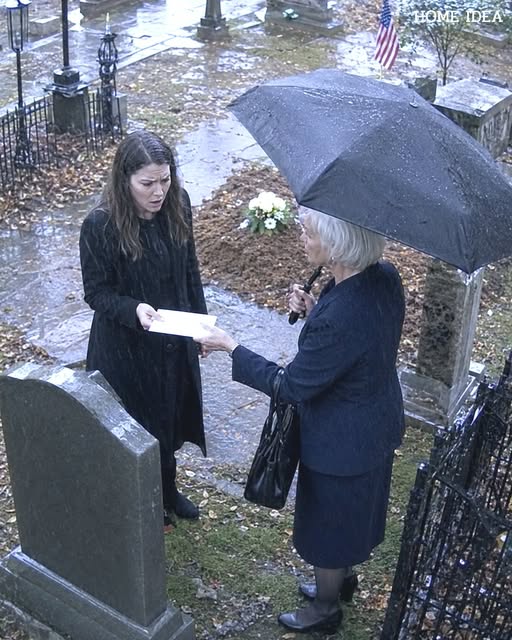
A woman in a dark coat stood a few feet away, holding a manila envelope under the edge of her umbrella. Her silver hair was pinned tightly. Her expression was professional, but her eyes were not cold.
“I’m Helena Lockwood,” she said. “Attorney for Stella Whitfield’s estate.”
Stella Whitfield.
The name sounded almost unfamiliar, even though she had lived next door for eight years.
I looked past Helena at the casket. “I’m sorry, I don’t understand. I barely knew her.”
Helena studied me carefully. “She knew that.”
The cemetery workers kept moving. The ropes tightened. The rain kept falling. No one said a prayer.
Helena held out the envelope.
My name was written across the front in careful handwriting.
Lissa Ashford.
My stomach tightened.
“She asked me to give this to you personally after her passing,” Helena said.
I did not take it right away.
Some part of me still heard Corbin’s voice.
Don’t engage.
Stay away.
She wants attention.
Helena’s hand stayed steady between us. “She said you would understand once you read it.”
The envelope looked ordinary. Brown paper. Sealed flap. Damp at the corners from the rain.
But the way Helena held it made it feel heavier than paper should ever feel.
“What is inside?” I asked.
Her eyes flicked toward the grave, then back to me.
“Truth,” she said quietly.
That word landed harder than it should have.
Truth.
Corbin used that word all the time. Our marriage was built on truth, he liked to say. Trust, honesty, transparency. He said it when he asked me to sign financial forms. He said it when I questioned why the fence had to be so high. He said it when he told me the woman next door was unstable.
He always said it gently.
That was the part that made people believe him.
I took the envelope.
The moment my fingers touched it, Helena released it quickly, as if she had been waiting years to stop carrying it.
“She wanted you to read it alone,” Helena said. “Not with your husband nearby.”
My eyes lifted to hers.
The rain slipped down the side of her umbrella in thin silver lines.
“Why would she say that?”
Helena did not answer immediately.
Behind her, the casket reached the bottom of the grave.
Something in the sound of the ropes against wet wood made my hands go cold.
“Mrs. Ashford,” Helena said, “Stella was afraid of your husband.”
My first instinct was to defend him.
That instinct had been trained into me for ten years.
Corbin is respected.
Corbin is careful.
Corbin protects me.
Instead, I looked at the envelope.
A corner of white paper showed through a slight gap in the flap. Documents. More than one page. Maybe many.
“I don’t know what she told you,” I said, “but Corbin said she had problems.”
Helena’s face changed.
Not shock. Not disbelief.
Pity.
“She told me he would say that.”
A cold line moved down my back.
The cemetery workers stepped away from the grave. One of them removed his cap. The other looked at the ground, uncomfortable, as if even strangers could feel the wrongness of that empty funeral.
I tucked the envelope against my coat.
Helena lowered her voice.
“She left copies of everything with me. If anything happens to the originals, there is still a record.”
“Originals?” I asked.
“The letter is only the beginning.”
My fingers tightened around the envelope.
Across the cemetery, a black car waited by the curb. My own car sat beyond it, windshield shining with rain. For one wild second, I imagined Corbin standing beside it, watching me, smiling that calm smile he used when he wanted me to feel foolish.
But he wasn’t there.
He was in Boston on business.
At least that was what he had told me.
Helena handed me a business card.
“Call me after you read it. Not before. And Mrs. Ashford?”
I looked at her.
“Don’t let him see your face when you learn what’s inside.”
The words were so controlled, so precise, that they frightened me more than shouting would have.
I drove home with the envelope on the passenger seat.
Every red light felt too long. Every passing car felt too close. The fence appeared before the house did, black iron cutting through the gray afternoon, tall and severe, rain sliding down the bars like it had been built to divide more than property.
I parked in the driveway and sat there, staring at it.
For eight years, that fence had made me feel safe.
Now it looked like a warning I had misunderstood.
Inside, the house was quiet. Corbin’s shoes were gone from the entry. His coffee mug sat rinsed beside the sink. Everything looked normal in the polished, careful way our life always looked normal.
At 11:47 p.m., I sat at the kitchen table and opened the envelope.
Nine handwritten pages slid out first.
Then bank receipts.
A construction permit.
A folded newspaper clipping.
And one smaller sealed packet labeled:
DNA test results.
The room seemed to shrink around me.
I unfolded the first page.
Dear Lissa, if you are reading this, I am gone. I am sorry you have to learn the truth like this, but there is no one else I can trust.
My hands stopped moving.
The next line was simple.
Ten years ago, I met your husband.
I read it once.
Then again.
Then a third time.
Rain tapped against the kitchen window. The fence stood outside in the dark. And for the first time in my marriage, I understood that Corbin had not built it to protect me.
He had built it to hide what was on the other side.
I reached for the sealed DNA packet.
Views: 7